PLA or PETG: which one to choose for your 3D printed part
PLA for decor and gifts; PETG for sun, cars and bathrooms. Differences, temperatures and how we decide at Lío with our Bambu Lab printers.
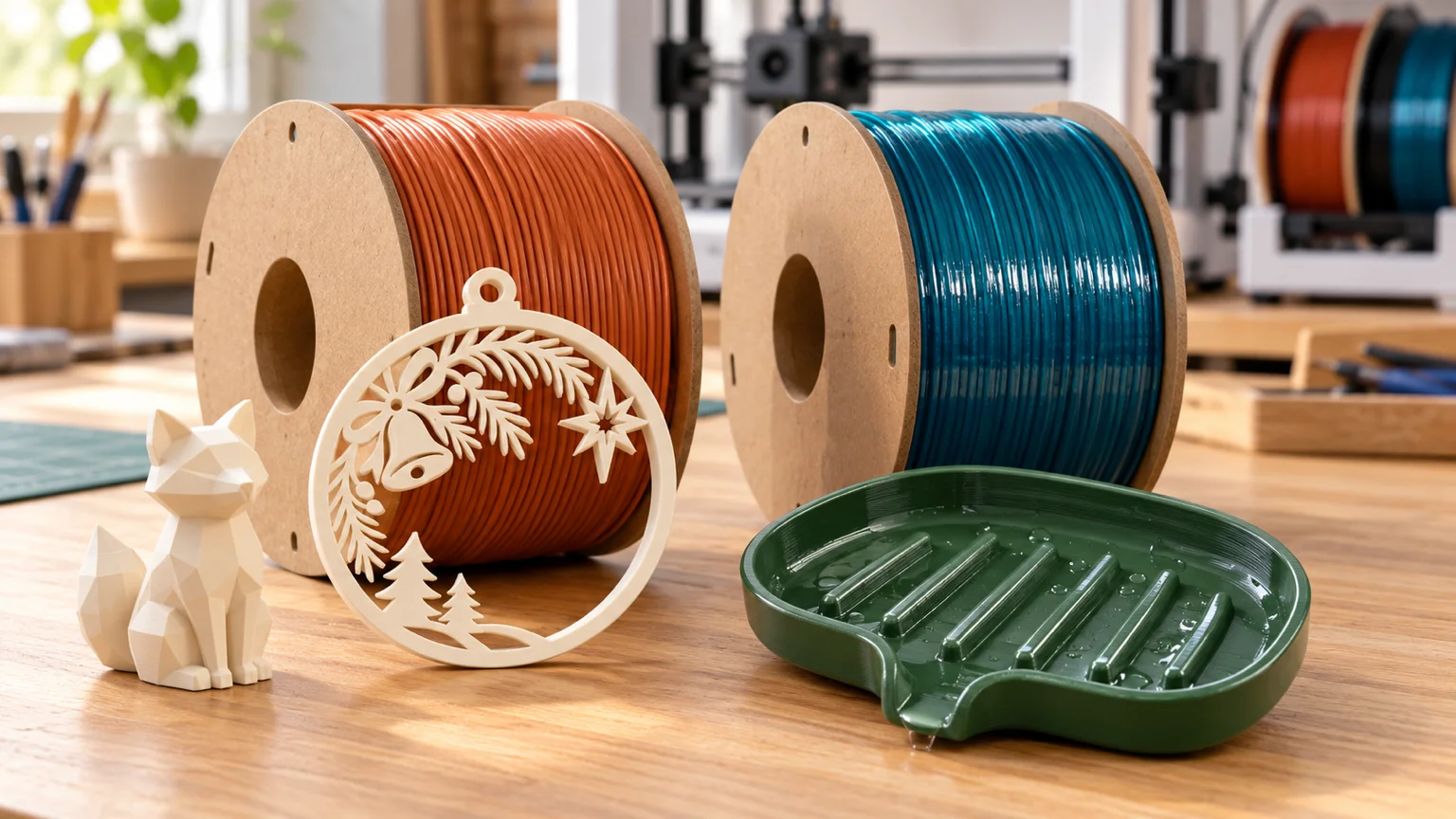
For indoor pieces such as gifts, ornaments, figures, keychains and models, choose PLA: it is the easiest to print, gives the best finish and comes in more colors. Choose PETG when the piece will sit in the sun, live in a car or a bathroom, or take knocks: it handles more heat, water and impact, at the cost of more stringing and more care with spool moisture.
At Lío we make this call every day: of the 1,923 products in our shop, 1,790 are printed in PLA and 125 in PETG. We print on two Bambu Lab machines, an A2L and an A1 mini, both with AMS.
How are PLA and PETG different?
| PLA | PETG | |
|---|---|---|
| Ease | Very easy | Easy; strings more |
| Nozzle | 190 to 230 °C | 230 to 260 °C |
| Bed | 35 to 45 °C | 65 to 75 °C |
| Heat | Up to about 55 °C | Up to about 70 °C |
| Sun and water | Warps and fades | Holds up better |
| Impact | Rigid; snaps | Bends before breaking |
| Finish | Crisper | Glossy, less crisp |
| Spool moisture | Less sensitive | More sensitive |
Nozzle and bed temperatures are the ones Bambu Lab lists for its PLA Basic and PETG HF (checked in October 2026). Other brands may ask for different values, so check the spool label.
When should you choose PLA?
- Indoor decor and gifts: Christmas ornaments, figures, keychains, signs and planters that stay out of the sun.
- Detail and color: it has the widest range of colors and finishes and shows small lettering and relief best. That is why our Christmas ornaments with names and custom keychains are PLA.
- Shape prototypes: to check sizes and fits before the final version.
Its weak spot is heat: keep it out of direct sun, closed cars and heat sources.
When should you choose PETG?
- Cars and motorbikes: sun visor glasses holders and phone mounts. More than half of our car and motorbike range is PETG.
- Bathroom and kitchen: soap dishes, drying racks and organizers that get wet every day.
- Outdoors: planters in the sun, garden parts and water bowls for pets on the patio.
- Working parts: replacement parts, clips, brackets and modular floor tiles that get walked on every day.
PETG has limits too: under constant heat and load it slowly gives way. Keep it below 70 °C and out of the dishwasher.
What to keep in mind when printing them on an A2L or an A1 mini?
Both are open-frame printers with no enclosure. They handle PLA and PETG well; Bambu Lab warns that on the A1, also open-frame, high-temperature materials such as ABS or ASA tend to warp on large parts. That is why, on an open printer, PLA and PETG are the practical choice.
- Bed: both reach 80 °C, according to Bambu Lab's specs. That is enough for PETG.
- Plate: on a smooth plate PETG can bond so hard that it tears the surface; Bambu Lab recommends a glue stick as a release layer. A textured PEI plate usually lets go of it more easily.
- Fits: our design tools use 0.15 mm of clearance in PLA and 0.2 mm in PETG. It is a good starting point for lids, hinges and snap-fit parts.
- Parts you walk on: modular floor tiles are PETG with 3 walls, 25% gyroid infill, textured PEI plate and no brim. Those are the settings built into our modular floor designer.
- Profiles: if you are starting out, begin with the filament's profile in Bambu Studio and change walls and infill first, based on the part's use.
Sources: Bambu Lab spec sheets for the A2L and A1 mini, and for PLA Basic and PETG HF filament, checked on October 20, 2026.
Why does PETG string, and what can you do?
PETG oozes more than PLA when the nozzle travels between points. The most common cause is moisture: a wet spool gives strings, bubbles and a rough surface. Bambu Lab recommends storing spools in a sealed container with desiccant, below 20% humidity, and drying them before use: PETG HF at 65 °C for 8 hours and PLA Basic at 55 °C for 8 hours, in a drying oven. In a humid climate, the open spool is the first thing to check.
Can you mix them in one print with the AMS?
Both work in the AMS, but they do not bond to each other. For a multicolor piece, use the same material for every color.
That flaw is also useful. In our 3D thermoforming tool the mold is PETG and the sheets are PLA: PLA softens under the heat gun before PETG does, takes the shape and does not stick to the mold. Some people use the same idea to get supports to release cleanly, with a PETG layer between a PLA part and its support. If you try it, start with a small part.
Which one costs more?
In our standard quote, PLA and PETG cost the same per gram. What changes the price of a part is the grams, the print hours and the finish. For a sense of prices, see our 3D printing price guide.
No printer, or no time to fight with settings?
We will print it for you. Tell us what the part is for and where it will live, and we will choose the material with you. If you are not sure, pick "Not sure, recommend one" in the quote form, or message us on WhatsApp at +57 300 115 2951.
Frequently asked questions
Is PETG better than PLA?
Not at everything. PETG handles more heat, sun, water and impact; PLA is easier to print, shows finer detail and comes in more colors. We use PLA for decor and gifts, and PETG for cars, bathrooms, outdoors and working parts.
Can I leave a PLA part inside a car?
We do not recommend it. A closed car in the sun gets hotter than PLA can take, and PLA deforms from about 55 °C. For the car, order it in PETG.
Can an open printer like the A1 mini print PETG?
Yes. Our A1 mini and A2L print PETG with the bed at the temperature the filament maker asks for; both reach 80 °C. Materials such as ABS or ASA are the ones that need an enclosed printer.
Are PLA or PETG food safe?
A 3D printed part has layer lines where dirt can build up, and it should not go in the dishwasher. We do not offer parts certified for food contact; ask us before ordering for that use.
I don't know which material my part needs. What should I do?
Tell us what it is for and where it will be (sun, water, car, indoors). In the quote form you can pick "Not sure, recommend one" and we will suggest the material along with the price.